ELANPRO SAKSHAM ADVANCES SAFETY, SUSTAINABILITY AND COMPLIANCE
-
By: Ift Trade
-
15 Sep 2026
-
Source-
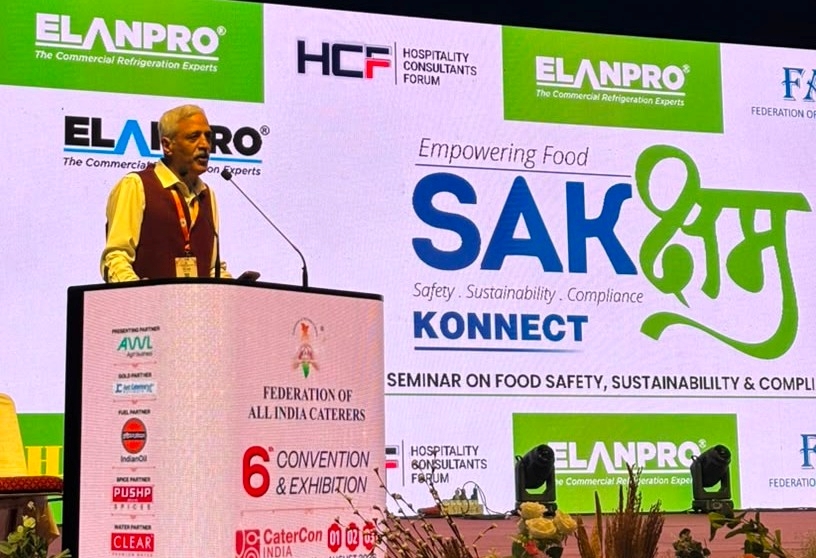
As India’s foodservice sector rapidly expands across corporate catering and hospitality, businesses face tighter regulatory enforcement alongside increasingly complex supply chains. Under high-volume, high-pressure conditions, the risk of critical oversights in food, water, and fire safety multiplies exponentially.
Having a valid licence or a statutory Fire NOC shows compliance on paper, but it does not guarantee daily operational safety when kitchens are pushed to their limits.
To bridge this gap between regulatory mandates and everyday execution, ELANPRO SAKSHAM has evolved from an awareness forum into a comprehensive, multi-disciplinary network. Rooted in Safety, Sustainability, and Compliance, the initiative unites regulatory guidance, technical expertise, and frontline industry experience—empowering hospitality professionals to embed rigorous safety standards into their daily kitchen operations.
For Elanpro, this initiative is an extension of its role in the foodservice industry beyond commercial refrigeration. In collaboration with the Hospitality Consultant Forum (HCF), the company has created a platform where regulatory guidance, technical knowledge and industry experience can come together around the practical issues.
The initiative has now reached six cities, with its recent editions held in Jaipur and Goa. The two editions brought conversations into distinct operating contexts, highlighting how safety and compliance challenges can vary across the foodservice and hospitality ecosystem.
Safety Across Different Operating Environments
The Jaipur edition, hosted alongside Catercon India, specifically addressed the challenges of mass catering and large-scale public events, where temporary kitchens, high volumes, extended holding periods, and tight service windows create vulnerable control points between food preparation and final service.
“In high-pressure catering environments, the real risk isn't deliberate non-compliance, it is inconsistency in execution. Licensing shouldn't just be viewed as a formal requirement, but as the foundation for daily quality and safety. The true shift happens when we move beyond enforcement to building robust workplace systems where competent people, strong leadership, and continuous verification ensure unsafe shortcuts are never normalised,” said Pawan Agarwal, former CEO of the Food Safety Standards Authority of India and Founder & CEO of the Food Future Foundation.
The Goa edition focused on the HoReCa ecosystem where food safety and compliance intersect directly with tourism standards, physical building infrastructure, and continuous fire safety protocols.
Speaking at the seminar in Goa, Shweta S. Dessai, Director, Food and Drugs Administration (FDA) & Commissioner, Food Safety, Goa, emphasised that Food Business Operators (FBOs) must approach commercial food preparation with the same meticulous care and attention to hygiene as meals prepared at home.
“In the hospitality sector, prioritising food safety is critical because food serves as a central pillar of the tourist experience. When visitors enjoy delicious cuisine prepared in full alignment with safety compliance, it creates a lasting, positive impression. Conversely, failing to adhere to food safety norms damages customer trust and directly undermines the broader reputation of Goa as a premier destination,” said Dessai.
The message across both editions was consistent that the nature of the risk may change with the operating environment, but safety cannot be reduced to documentation or periodic inspection. It has to be built into everyday processes.
Fire Safety: From Certification to Continuous Readiness
The same principle applies to fire safety, where obtaining a statutory Fire No Objection Certificate (NOC) establishes compliance at a particular point in time, but does not by itself ensure that a facility remains safe during daily operations.
Hospitality kitchens carry specific risks, including cooking oils and fat fryers, LPG leaks and poorly maintained exhaust systems.
Discussions at ELANPRO SAKSHAM in Goa also highlighted the role of appropriate safeguards such as K-class wet chemical suppression systems, fusible links and gas leak detectors. It was also stressed that human response is equally important. The hotel staff need to understand emergency procedures, evacuation routes and their individual responsibilities before an incident occurs.
“Fire safety is not achieved merely by installing equipment or obtaining a certificate; it is achieved when management takes direct ownership, systems are actively maintained, and every single employee knows their exact role in an emergency. Electrical safety, clear escape routes, and functional alarm systems are not technical details; they are management responsibilities. A building that is compliant today must remain safe tomorrow through daily discipline, continuous training, and zero compromise on unsafe shortcuts,” said Dr. Nitin V. Raiker, Director, Fire & Emergency Services, Goa.
The participation of both food and fire safety authorities in the Goa edition also reinforced the broader scope of the initiative’s safety pillar - food safety and fire safety may involve different systems and expertise, but both ultimately depend on preparedness, accountability and consistent execution.
Building Knowledge Where Industry Needs It
The Jaipur and Panaji editions showcase ELANPRO SAKSHAM’s expansion across different segments of the food and hospitality industry. From mass catering and large-scale events to hotels, restaurants and other hospitality businesses, the sessions have brought different operational concerns into a common discussion around safety and compliance.
Its broader objective is to make regulatory and technical knowledge more accessible to businesses that may not have the same depth of in-house expertise or resources as larger organised players.
Speaking about the initiative Sanjay Jain, Director, Elanpro said, “Ultimately, compliance is only as strong as its implementation. The real measure of a standard is not whether it is documented or certified, but whether it is consistently upheld when the kitchen is busy, the operation is under pressure and no one is there to inspect it.”
With its outreach continuing across cities and industry segments, ELANPRO SAKSHAM is building on this approach to take the conversation around Safety, Sustainability and Compliance to more businesses across the food and hospitality ecosystem.